


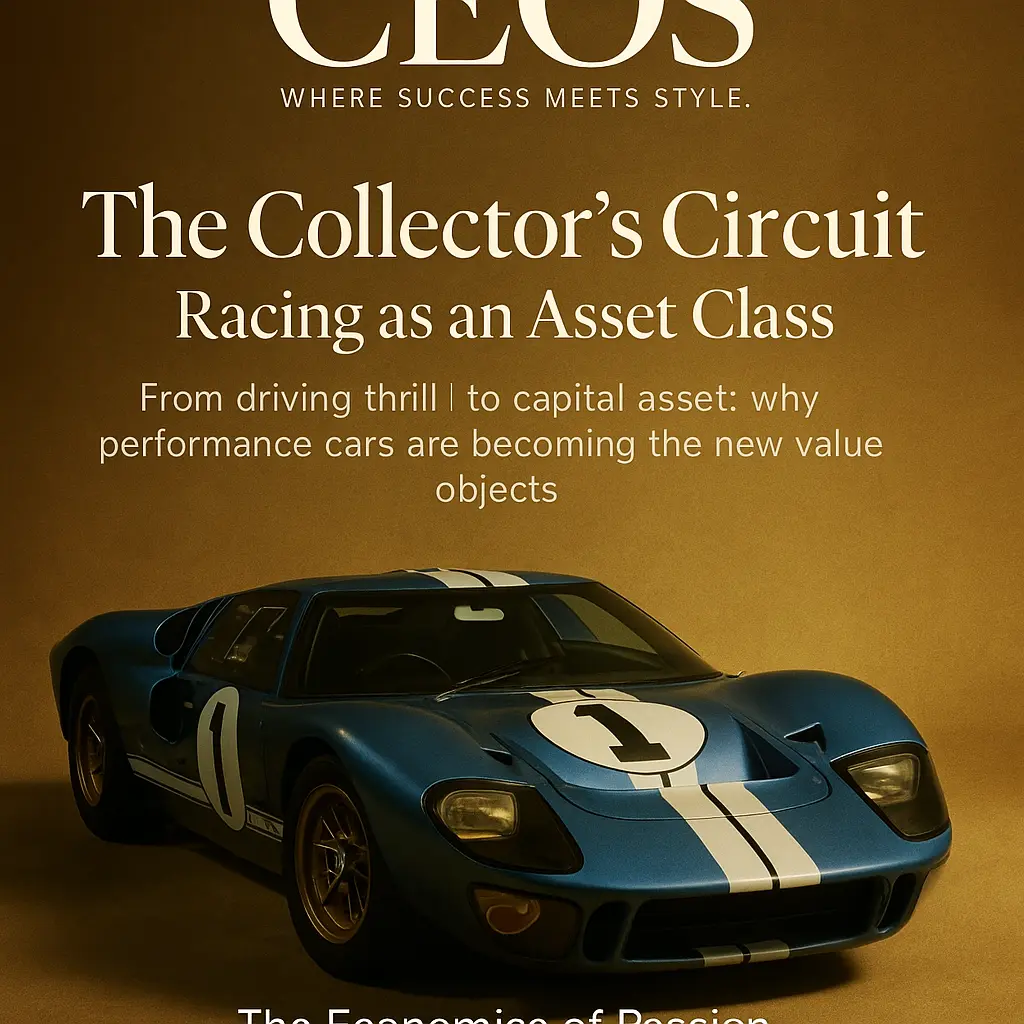
From Driving Experience to Capital Asset: Why Performance Cars Are Becoming the New Symbols of Value
When Passion Becomes Profit
A 1967 Ford GT40 changes hands at RM Sotheby’s for $9 million.
It’s more than an auction — it’s a statement.
A moment where emotion, heritage, and capital merge into a new form of value creation.
What was once the domain of enthusiasts with gasoline in their veins has become a serious investment class with both substance and soul.
Performance cars, historic race prototypes, and limited-edition hypercars have evolved into mobile monuments — tangible assets that preserve wealth, define identity, and project status.
The New Asset Class on Wheels
In the world of global investments, automobiles have become the fifth art form — alongside paintings, sculptures, watches, and fine wine.
International auction volumes have doubled since 2015. According to the Knight Frank Luxury Investment Index, the value of rare sports cars has risen by an average of 185% over the past decade.
In 2023, a Ferrari 250 GTO sold for over $51 million, while icons like the Porsche 911 Carrera RS 2.7 and the McLaren F1 now trade at the same level as museum-grade art.
As one collector put it:
“A car that makes history isn’t a purchase — it’s an acquisition of cultural capital.”
Performance Meets Provenance
The collector’s market follows a clear logic — and a new form of intelligence.
Not every fast car becomes an investment. What matters is provenance, rarity, innovation, and narrative power.
A Ferrari F40 without history is a classic.
An F40 with documented Le Mans pedigree becomes an asset.
“Collecting isn’t coincidence,” says Marc Levandowski, curator of an automotive asset collection based in Palm Beach.
“We value automobiles like paintings — by authenticity, condition, originality, and emotional resonance.”
The allure lies in the intersection of engineering and mythology — machines that don’t just move, but tell stories.
Family Offices Discover Mobile Value
Private wealth managers and family offices now view high-performance vehicles as a strategic diversification tool.
In volatile markets, tangible automotive assets offer a rare combination of stability and sentiment.
A Swiss family office partner puts it succinctly:
“In a market where trust is volatile, we invest in things that endure — and evoke desire.”
The returns are not just financial. They’re symbolic — exclusivity, access, and narrative ownership.
From Racetrack to Portfolio
Specialized funds such as the Curated Motors Heritage Fund (U.S.) and The Classic Car Trust (Switzerland) are institutionalizing the collector car market.
Their models mirror private equity structures:
Acquisition – Restoration – Preservation – Exit.
But unlike other assets, automobiles offer an additional dividend: experience.
Owning a McLaren F1 or a Porsche 917 isn’t passive wealth — it’s a sensory investment, a dialogue between mechanics and emotion.
The Aesthetics of Appreciation
Design becomes interest. Sound becomes yield. The curve becomes a metaphor for time.
The value of a car increases when engineering meets emotion — when craftsmanship and storytelling merge.
A Porsche 904 Carrera GTS is coveted not just for its rarity, but because it embodies an era — the union of speed, art, and handcraft.
“Value arises when form and function create a story,” says Thomas König, founder of the Classic Car Museum in Los Angeles.
The collector market follows its own cultural logic: authenticity outweighs perfection.
A slightly patinated Aston Martin DB4 GT is worth more to collectors than an over-restored one — because it breathes truth.
Hypercars: The Modern Renaissance
Beyond the classics, a new segment is taking shape — the Hypercar Economy.
Models like the Pagani Huayra R, Aston Martin Valkyrie, and Koenigsegg Jesko Absolut are sold out before they even hit production.
Limited runs, hand-signed engines, carbon monocoques — every element is designed to manufacture rarity.
Today, a Pagani is treated like a Stradivarius: paired with certificates, provenance files, and a global resale network.
As one investor noted:
“The hypercar is the NFT of mechanics — scarce, tradable, iconic.”
The Curators of Speed
A new profession defines this market: the Automotive Curator.
Part historian, part financier, part connoisseur — they craft portfolios where emotion meets economics.
Working alongside art advisors and auction houses, they develop narratives ranging from Le Mans legends to Pininfarina’s design DNA.
Their mission: to secure automotive heritage as cultural capital — and translate it into modern wealth.
Market Data & Value Trends
Category Average Value Growth (10 Years) Example Models
Historic Race Cars +200% Ford GT40, Ferrari 250 LM, Porsche 917
Youngtimers (1980–2000) +145% BMW M3 E30, Ferrari F355, Acura NSX
Hypercars (Limited Series) +120% Pagani Zonda Cinque, McLaren P1, LaFerrari
Modern Collectibles (EV & Hybrid) +80% Rimac Nevera, Porsche 918 Spyder, Tesla Roadster Founders Edition
Conclusion: Mobility as a Store of Wealth
The collector car market represents the evolution of modern luxury — where emotion, engineering, and financial intelligence intersect.
Cars that made history aren’t mere objects — they are relationships between man, machine, and time.
They remind us that true value arises not from horsepower or rarity alone, but from the fusion of passion and purpose.
Insight: Performance fades — significance endures.
A feature from the series “The Economics of Passion” – exclusively in
CEOs – The Lifestyle of Power
Where Success Meets Style.
