


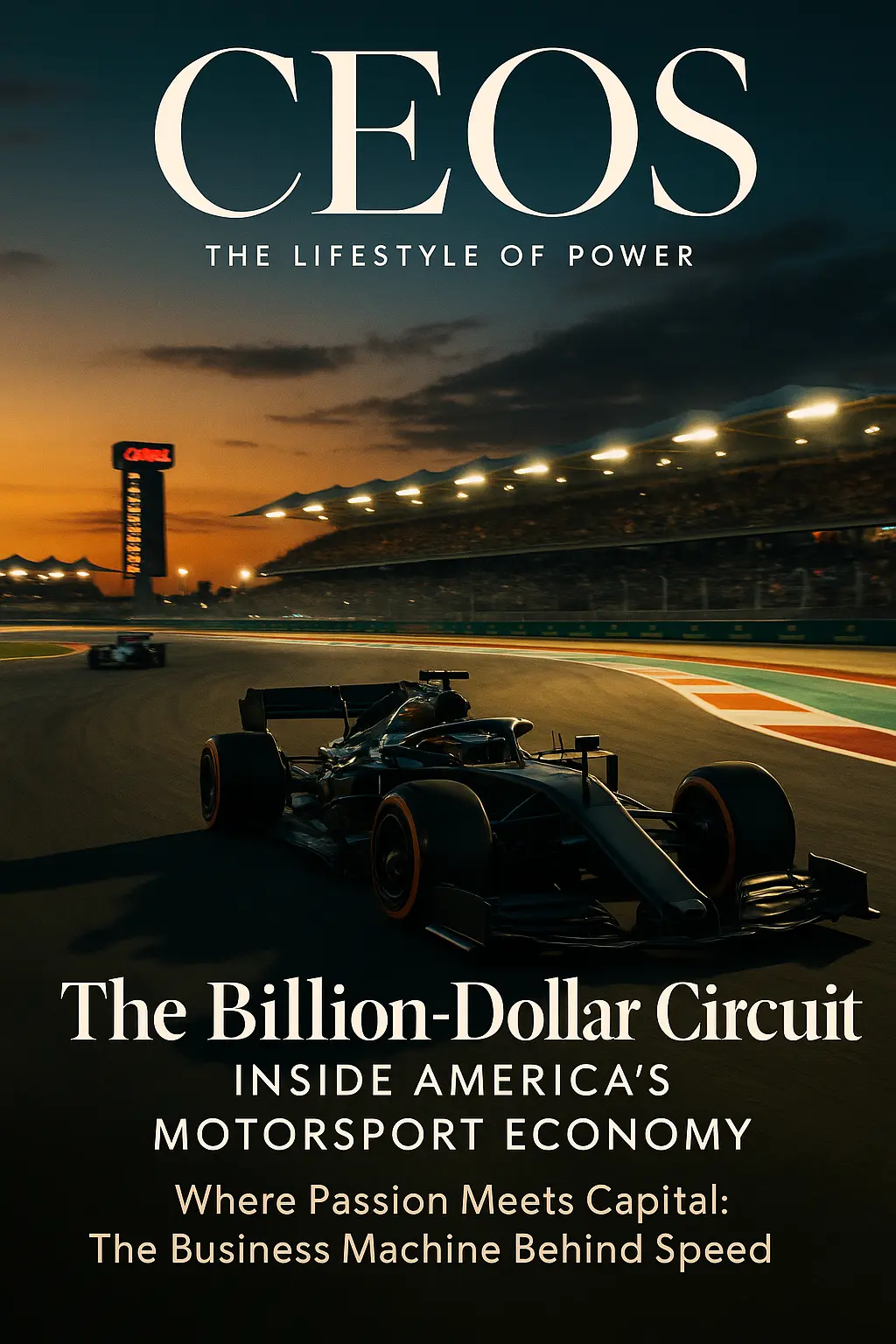
Where Passion Meets Capital: The Business Machine Behind Speed
When Adrenaline Becomes Currency
When the engines roar across the Circuit of the Americas in Austin, Texas, the crowd feels more than horsepower — they feel economic velocity measured not in seconds but in billions. Over 400,000 fans attended the 2024 U.S. Grand Prix — a weekend that ignited not just asphalt, but entire markets.
What unfolds there is no longer traditional racing. It’s a symphony of brands, capital, and emotion — a living portrait of how performance, prestige, and profit merge in the 21st century.
The New Motorsport Capitalism
The United States is experiencing a motorsport renaissance — economically, culturally, and as a spectacle of power. Formula 1, once dismissed as a European curiosity, has been transformed by Liberty Media into a global luxury product.
Since acquiring F1’s commercial rights in 2017 for roughly $8 billion, Liberty has repositioned the sport entirely:
- From niche competition to lifestyle platform
- From pit lane to content economy
- From engine roar to media resonance
Netflix’s Drive to Survive turned racing into a narrative universe, where drivers became protagonists and teams evolved into brand ecosystems.
The financial outcome:
Formula 1 revenue climbed above $3.2 billion in 2024, with an EBITDA of $620 million. U.S. races alone — Austin, Miami, Las Vegas — now generate over $1 billion in direct economic impact each year.
Corporate Speed – When Brands Own the Asphalt
Motorsport today is not merely a stage — it’s an economic microcosm, where every meter of track is monetized.
Sponsorship as an Ecosystem
Companies like Oracle, Red Bull, Aramco, and Rolex invest hundreds of millions each year not just to show logos, but to own emotion. A spot on a Formula 1 chassis is no longer advertising space — it’s capitalized desire.
- Oracle Red Bull Racing: estimated $300 million per year in sponsorship
- Mercedes-AMG Petronas: around $75 million annually
- Aston Martin & Cognizant: a strategic rebrand powered by tech partnerships
Hospitality as Business Strategy
In the Paddock Club, deals replace pit stops. It’s where private equity funds meet tech founders, and contracts are sealed over champagne instead of spreadsheets.
A single weekend in a corporate suite can be more productive than months of negotiations — because emotion breeds trust.
“Motorsport isn’t sponsorship — it’s economic diplomacy in real time.”
– Mark Gallagher, motorsport economist and former F1 executive
From NASCAR to Vegas: America’s New Brand Engine
NASCAR, once the heartland symbol of middle-class America, has reinvented itself through digital modernization, hybrid engines, and lifestyle storytelling. It’s no longer a regional pastime — it’s an emotionally intelligent brand platform.
Meanwhile, Las Vegas has become the new spiritual home of global motorsport. The 2023 Las Vegas Grand Prix generated $1.2 billion in local economic output, according to Deloitte — outpacing even the Super Bowl.
The blend of glamour, gaming, and velocity has turned Vegas into a laboratory for event capitalism, where luxury, media, and experience converge.
Tech Billionaires and the New Motorsport Futurism
Behind the grandstands lies a different race — the one for data, innovation, and influence.
- Liberty Media leverages racing as a content engine for digital storytelling.
- Red Bull US merges performance marketing with entertainment economics.
- Elon Musk, Jeff Bezos & Co. invest indirectly — in satellites, cloud infrastructure, and autonomous systems that underpin the sport’s evolution.
For Silicon Valley’s elite, motorsport isn’t a playground — it’s a sandbox for precision, data, and brand psychology.
“Speed is a data phenomenon. Whoever measures motion controls the narrative.”
– Investor and race team consultant, Palo Alto
The Numbers Behind the Passion
- Total U.S. Motorsport Market: over $15 billion annually
- Corporate Hospitality & Sponsorship Share: approx. $5.4 billion
- Economic Output per F1 Weekend: $450-700 million
- F1 Market Growth (North America): +12% annually since 2020
These figures reveal a transformation: Motorsport has evolved into a platform economy, where data, experience, and capital accelerate in real time.
The New Code of Speed
Speed once symbolized risk. Today, it represents return and relevance.
Motorsport has evolved beyond adrenaline — it’s become architecture for business, where technology, luxury, and strategy intersect.
Formula 1 is no longer a sport — it’s a global communication engine, orchestrated with the precision of a Swiss watch and the emotion of a Hollywood production.
Key Facts
- U.S. Motorsport Economic Impact: Approx. $15B per year
- F1 Growth Rate (North America): +12% p.a. since 2020
- Top-Team Sponsorship Volume (Red Bull, Mercedes, Ferrari): $250–350M annually
- Circuit of the Americas (Austin): $290M local impact per event
- Corporate Hospitality / VIP Sector: Up to 30% of total event revenue
Conclusion: Speed as a Business Model
Racing is no longer just sport — it’s economic choreography.
A dynamic arena where brands trade trust, investors monetize emotion, and technology becomes the ultimate currency.
Motorsport is the business engine of the modern era: rational in construction, emotional in marketing, and global in scale.
Insight: Speed is not an escape from time — it’s the most valuable way to use it.
An exclusive feature from the series “The Economics of Passion” — presented by
CEOs – The Lifestyle of Power.
