


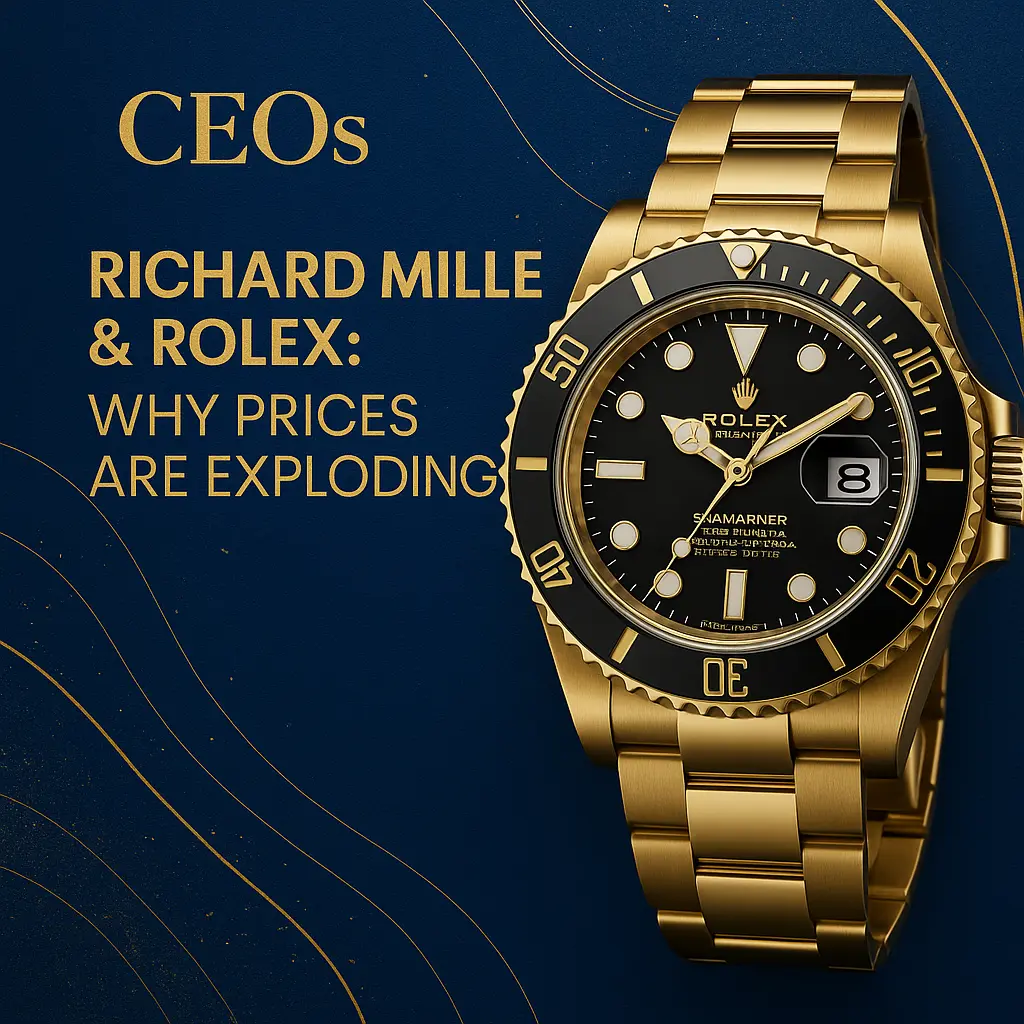
Richard Mille & Rolex: Why Prices Are Exploding
When timepieces become assets — and luxury becomes a new asset class.
There are two names dominating the global watch market right now unlike anything else:
Richard Mille and Rolex.
Two brands. Two philosophies.
And yet the same reality:
Their prices are rising faster than most stock indices, real estate markets, or private-equity funds.
The ultra-wealthy aren’t simply buying watches anymore.
They’re buying mobile status, symbolic capital — and above all, scarcity.
Why are prices exploding?
The answer begins where mechanics meet mythology.
Richard Mille: Formula 1 for the Wrist
Richard Mille isn’t a watch brand.
It’s a performance brand. A technical manifesto. A form of luxury extremism you don’t need to explain — you just recognize it.
Why demand is skyrocketing:
- Ultra-limited production — sometimes only a few dozen pieces.
- High-tech materials like Carbon TPT, graphene, and Grade 5 titanium.
- High-visibility ambassadors (Nadal, Bubba Watson, Formula 1 elite).
The “RM Effect”: If you wear a Mille, you’re broadcasting a public identity signal.
Richard Mille represents the new mindset of the ultra-rich:
It’s no longer enough to be wealthy.
You must be recognizably wealthy.
Rolex: The Immortal Classic
Rolex is the opposite of Richard Mille — and that’s exactly what makes it untouchable.
It is tradition, reliability, and iconography.
Why Rolex prices are soaring:
- Chronic undersupply — engineered or not, it works.
- Model icons like the Daytona, Submariner, Pepsi, and Panda.
- A global trust symbol: Rolex is the Amex Centurion of watchmaking.
- A secondary-market boom: The hottest models behave like stocks.
While other brands chase trends, Rolex defines the baseline:
It is the “luxury-for-the-elite” staple — and the benchmark for everyone else.
Scarcity Economics: Luxury in the Age of Limits
The core factor behind both brands? Controlled scarcity.
Richard Mille produces roughly 5,000 watches a year.
Rolex stays silent — but the market knows:
There are far too few pieces for far too many buyers.
Scarcity has a currency: attention.
Attention fuels demand.
Demand fuels appreciation.
The Ultra-Wealthy Want Stable Assets
Why watch investing is booming:
- High value stability, even in crises
- Extremely low depreciation
- Strong global liquidity in the resale market
- Perfect portability (an asset you can slip into a jacket pocket)
A Richard Mille or Rolex isn’t a purchase.
It’s a movable asset.
The Psychology: Power on the Wrist
Wealthy men don’t wear watches.
They wear signals.
A Richard Mille says:
I play in a league that defines itself.
A Rolex says:
I’m not a tourist in the world of success — I live here.
Both brands speak the same language — just in different dialects.
Outlook: Will Prices Climb Further?
In one word: Yes.
As long as wealth grows, visibility matters, and limited goods stay limited, both brands will continue to dominate.
Entry prices rise.
Waitlists grow.
Demand? Explosive.
We live in an era of visible success — and in the end, only two brands embody this narrative perfectly:
Richard Mille and Rolex.
