


From Engine to Icon: Why Performance Has Become a State of Mind
The Elegance of Acceleration
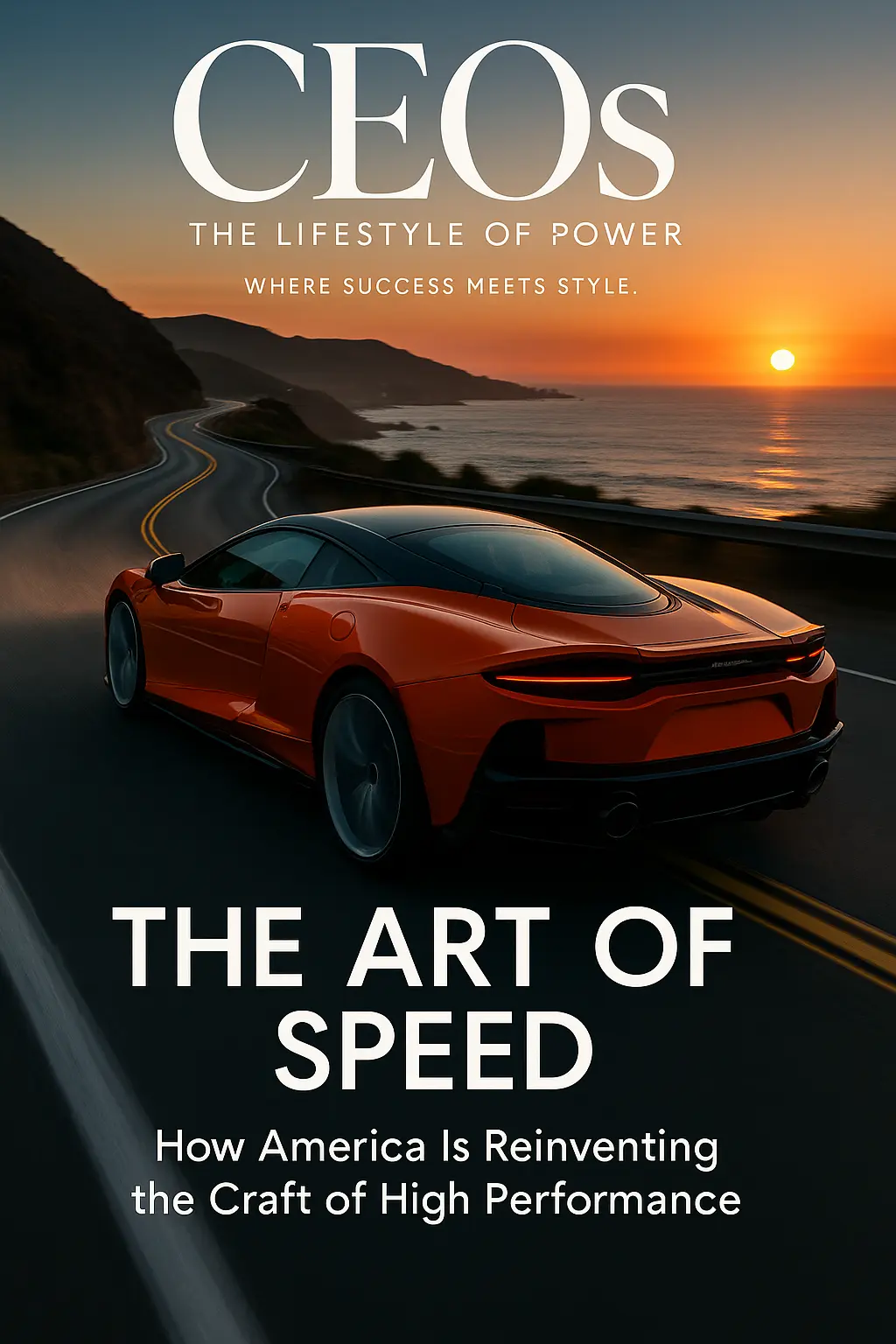
A McLaren GT cuts a glowing ribbon of light along the California coastline, the asphalt shimmering as the sun sets over Malibu. No chaos, no noise—only precision, rhythm, and control. Speed here isn’t an escape; it’s an aesthetic discipline, an expression of composure where power meets restraint.
In that image lies the essence of American performance culture: the pursuit of perfection beyond purpose. A nation that once built engines now builds brands—blending emotion, design, and engineering into cultural identity.
From Torque to Meaning
America’s new high-performance ateliers—Hennessey Performance, Singer Vehicle Design, Gunther Werks—extend what once began in Detroit’s age of mass production: the narrative of speed. But their ambition is different. It’s no longer about horsepower—it’s about personality.
John Hennessey calls it “Performance as Art.”
Rob Dickinson, founder of Singer, describes it as “Reimagination of the classic form.”
Peter Nam of Gunther Werks calls his vision “handcrafted precision in a digital age.”
These brands transform automobiles into limited-edition sculptures of carbon fiber, leather, and sound. They don’t just build cars—they cultivate desire.
Craftsmanship as High-End Philosophy
While the global industry chases electrification and autonomy, a counter-movement rises—a renaissance of the mechanical experience.
At Singer, a classic Porsche 911 is stripped, restored, and reborn through over 4,000 hours of meticulous handcrafting. No bolt untouched, no stitch accidental. The result is more than machinery: it’s an emotional choreography of form, function, and memory.
“To drive a Singer,” says one Los Angeles collector, “is like moving a living piece of art—responsive, resonant, and timeless.”
This new school of performance craft fuses analog passion with digital precision, creating value that transcends the automobile itself.
Design Meets Investment – A New Asset Class of Emotion
What once was a collector’s indulgence has become an investment category. Limited-production performance vehicles now fetch art-level prices at auctions.
A Gunther Werks 400R can reach seven figures. A bespoke Hennessey Venom F5—built in just 24 units—is considered a mobile sculpture for clients who see exclusivity as currency.
For family offices and collectors, the high-performance sector represents an emotional asset class—uniting tangible value, brand charisma, and cultural significance.
“These vehicles are more than machines,” says a California-based investor. “They are expressions of attitude—and attitude is the one thing that cannot be replicated.”
The Culture of Speed – America’s Reinvention
In the 1960s, speed symbolized freedom. In the 1990s, it stood for excess. Today, it represents discipline and excellence.
Modern American performance houses reconcile these contrasts—tradition and technology, luxury and restraint, rationality and emotion.
Hennessey tests engines across the vast plains of Texas. Singer refines aesthetic perfection in California. Gunther Werks translates racecraft into the language of the everyday driver. Together, they prove: speed is not an end, but a metaphor for precision of thought.
In an era defined by digital uniformity, the sound of a finely tuned engine remains an analog manifesto—a rebellion against sameness.
Performance as Identity
In this new era, performance isn’t a metric—it’s a narrative.
Driving a handcrafted Californian machine is not about wealth; it’s about refinement—the ability to distinguish quality from quantity.
It’s the same ethos that separates haute horlogerie from mass production, or haute couture from fashion. True performance begins where precision becomes emotion.
Every Hennessey, every Singer, every Gunther Werks tells a story—of daring, patience, and the art of never settling for average.
Voices of the Scene
“An engine is just the heart. The soul is born in the dialogue between hand, eye, and idea.” – Rob Dickinson, Singer Vehicle Design
“Performance isn’t an escape forward. It’s the refusal to stand still.” – John Hennessey, Hennessey Performance
“We don’t build cars. We preserve emotion—in aluminum and leather.” – Peter Nam, Gunther Werks
Key Facts
Hennessey Performance – 1991 – Texas, USA – Extreme Engineering – Power as a form of precision craft
Singer Vehicle Design – 2009 – California, USA – Reimagination – Classic design as emotional perfection
Gunther Werks – 2017 – California, USA – Carbon & Craft – Analog soul, digital precision
Conclusion: Speed as a State of Mind
Speed is not an escape—it’s a statement.
An expression of self-control, respect for engineering, and the quiet beauty of motion when mastery meets grace.
America’s new generation of performance ateliers proves that craftsmanship, precision, and passion are not contradictions—but the pillars of a lifestyle where success and aesthetics converge.
Insight: True speed isn’t born from acceleration— it’s the art of mastering control.
An exclusive feature from the series “The Art of Performance” in CEOs – The Lifestyle of Power.
